Cloud Computing
"This model of technology adapts to the needs of the company at all times, which only pay for what you use"
-Cost - Device and location independent
-Virtualization - Multitenancy
-Reliability - Scalability and Elasticity
-Performance - Security
-Maintenance
- Proven integration network services
- Services at world level
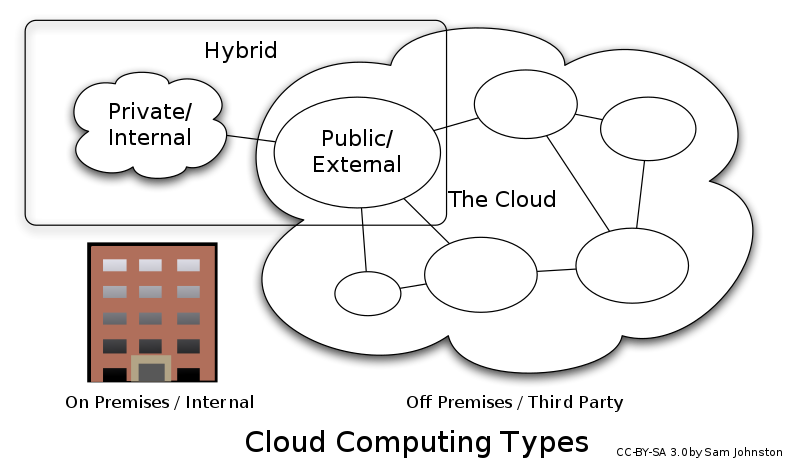
- A 100% infrastructure of cloud computing allows the content provider or services in the cloud without installing any type of hardware, since it is provided by the supplier of the infrastructure or platform in the cloud.
- Implementation faster and with less risk.
- Automatic updates that do not negatively affect it resources.
- It contributes to the efficient use of energy.
- Centralization of applications and data storage creates an interdependence of service providers.
- Application availability is tied to the availability of Internet access.
- "Sensitive" data of the business do not reside in facilities of the companies, which could result in a context of high vulnerability to the theft or theft of information.
- The reliability of the services depends on technological and financial "health" of cloud service providers.
- The availability of highly specialized services could take months or even years that they are feasible to be deployed in the network.
- Functional maturity of applications that they are continuously modifying its interfaces, so the companies of non-technological orientation learning curve has a significant pending, as well as automatic consumption by applications.
- Security.
- Scalability in the long term.
Prominent contributors to today's electrically energized world
Thomas A. Edison (1847-1931), the most productive electrical explorer. He invented the electric light bulb and many other products that electricians use or install
Georg Simon Ohm (1789-1854), a German physicist and the discoverer of Ohm's Law, which states that resistance, equals the ratio of the potential difference to current
Nikola Tesla (1856-1943), a Serbian-American inventor who discovered rotating magnetic fields. George Westinghouse purchased Tesla's patent rights.
George Westinghouse (1846-1914), an able adapter of other people's research, purchased their patents and expanded on their work. His first patent was received for a train air brake. In 1869, he formed the Westinghouse Air Brake Company. Eventually, he held 360 patents and founded six companies. He lost
control of his companies in the 1907 panic, but went on working for them for another three years. The experiences of electricity's founding fathers parallel in many ways the electronic technology breakthroughs of the past half-century that have brought us a whirlwind of innovation in computer hardware, software, and Internet communications. Just as a wave of electrical inventions dramatically changed the world as the 20th century progressed, so can we anticipate a steadily escalating rate of innovation in these emerging electronic disciplines beyond the dawn of the 21st century
Engineers that Changed the World - Nikola Tesla
Nikola Tesla was one of the greatest scientists and inventors who lived during the period 1856 - 1943. His inventions are present in many aspects of science - but he is mainly known for inventing the radio and the use of alternating current.
Nicola Tesla
Tesla's Own Company As it was mentioned in the first part, Tesla (a Croat by nationality and Austo-Hungarian by citizenship) had emigrated to US and worked with Thomas Alva Edison. However, as they were having constantly disagreements whether direct current (Edison's "love") or alternating current should be researched more, Tesla parted ways with Edison and eventually started his own business. He formed his own company "Tesla Electric & Light Manufacturing" in 1886 under that banner, Tesla created some of his most creative work and the greatest inventions ever known.
A large part of Tesla’s work was concentrated on wireless transmission of AC electricity over large distances. He maintained: “Ere many generations pass, our machinery will be driven by a power obtainable at any point of the universe.” Something that today is taken for granted and is known as the Tesla effect. In subsequent years till 1900, Tesla's work revolved around X-Rays, high frequency AC, transmission of electromagnetic energy, and building the first radio transmitter (the Nobel Prize for which, however, was given to Marconi), and mainly wireless transmission. He also built Warden Clyffe, the first wireless power transmission facility. The company, however, was indulged in a "War of Currents" with Edison (Ac v/s DC) which led to the bankruptcy of Edison's company, but also damaged the Tesla's company financial infrastructure
Electrical engineering Electrical engineering is a field of engineering that generally deals with the study and application of electricity, electronics and electromagnetism. The field first became an identifiable occupation in the late nineteenth century after commercialization of the electric telegraph and electrical power supply. It now covers a range of subtopics including power ,electronics, control systems, signal processing and telecommunications. Electrical engineering may include electronic engineering. Where a distinction is made, usually outside of the United States, electrical engineering is considered to deal with the problems associated with large-scale electrical systems such as power transmission and motor control, whereas electronic engineering deals with the study of small-scale electronic systems including computers and integrated circuits. Alternatively, electrical engineers are usually concerned with using electricity to transmit energy, while electronic engineers are concerned with using electricity to process information. More recently, the distinction has become blurred by the growth of power electronics

One of the best things that electronics have given our society in the 21st century was sending men on the moon and subsequently into other planets. Without the use and development of the proper electronic tools, we would never have reached the heaven, leave our footprints on the moon and pitch the American flag on the lunar partner.
Without electronics, we would have to endure dark nights, lit only by candlelights and torches and we also had to suffer from the biting cold or the sweltering heat depending on where you live.
Electronics such as electric fans, airconditioning units and heaters have all given us a better life. The electricity that powers our homes and illuminates our lives is also of our electronics products and those complicated looking equipment found in power plants around the country.
Education has also been tremendously impacted thanks to the improvements in electronics. Schools are no longer limited to blackboards in teaching. Teachers can now use audio-visual materials in order to help children learn their ABCs or their 123s.
The business and financial sector have also greatly improved thanks to the contributions of the electronics. Businessmen can now sit comfortably in their offices and meet or talk with prospective clients or with their business partners through wireless cables and other electronic equipments like the desktop computers or the laptops and webcams.
Business presentations have also become easier thanks to the miracles of electronics. Business people can now enjoy save more time writing on the board during a conference or a meeting and instead show a presentation using a powerful projector.
Buying and selling stocks have also become easier as communication has improved with the help of electronics. Stockbrokers no longer have to write down every new deal close because they can easily input everything through various equipments that are specifically available for brokers or people involved in the Stock Market.
Finally, thanks to electronics, everything seems to be connected, it has made life brighter, cities more enjoyable and safe and made homes more comfortable. It has also made life better in terms of work and in terms of connecting with other people either in school or outside.